
How to Choose the Right Air Duct Cleaning Company in Dana Point
Any company can say they use “industrial equipment.” The question that actually separates a real contractor from a low-bid operation is simpler: what’s your CFM rating, and how do you verify negative pressure during the job? Most homeowners never ask it, which is exactly why a coupon ad and a proper duct cleaning can look identical on paper. Choosing well in Dana Point comes down to verifying technical capability, not comparing star ratings.
If you’d rather skip the research and talk to someone who can answer those questions, call (855) 629-3179.
Key Takeaways
- Ask about CFM rating and negative-pressure verification before anything else.
- The NADCA ACR standard is the benchmark a legitimate company can reference by name.
- Truck-mounted equipment matters in Dana Point’s multi-story homes for power and hose reach.
- A real pre-job inspection comes before any add-on is mentioned.
- Licensing and insurance are checkable facts in California, not sales talk.
Why Reviews and Price Alone Won’t Tell You Much
Reviews tell you whether someone was pleasant and on time. Price tells you what someone is willing to charge. Neither tells you whether their equipment can create and hold negative pressure across your particular duct layout, and that’s the variable that decides whether dust leaves the system or just gets stirred around your living room.
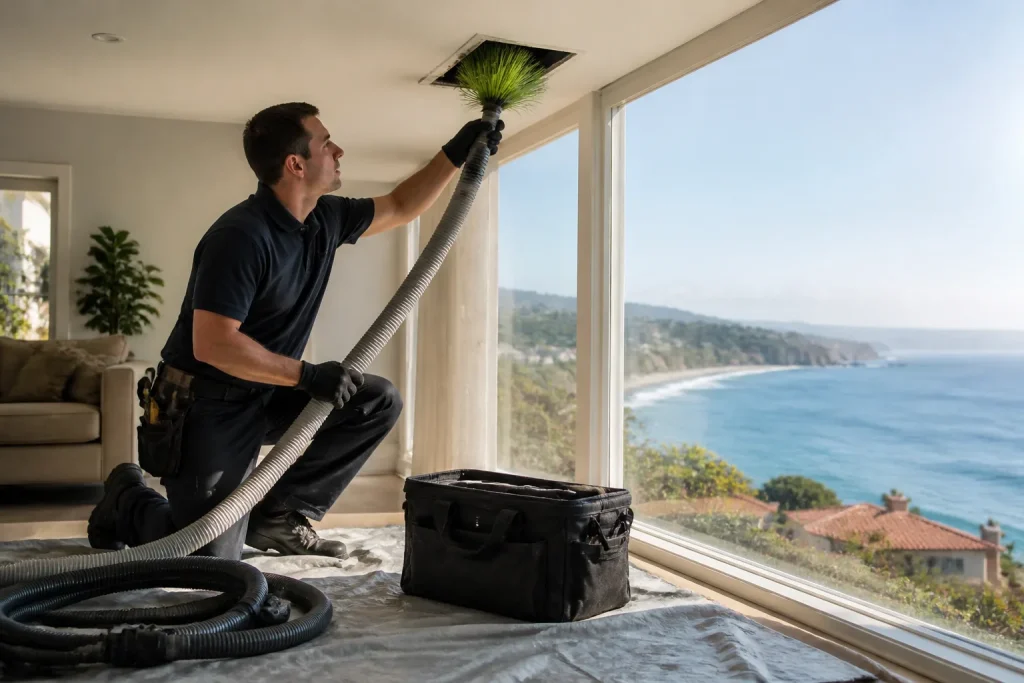
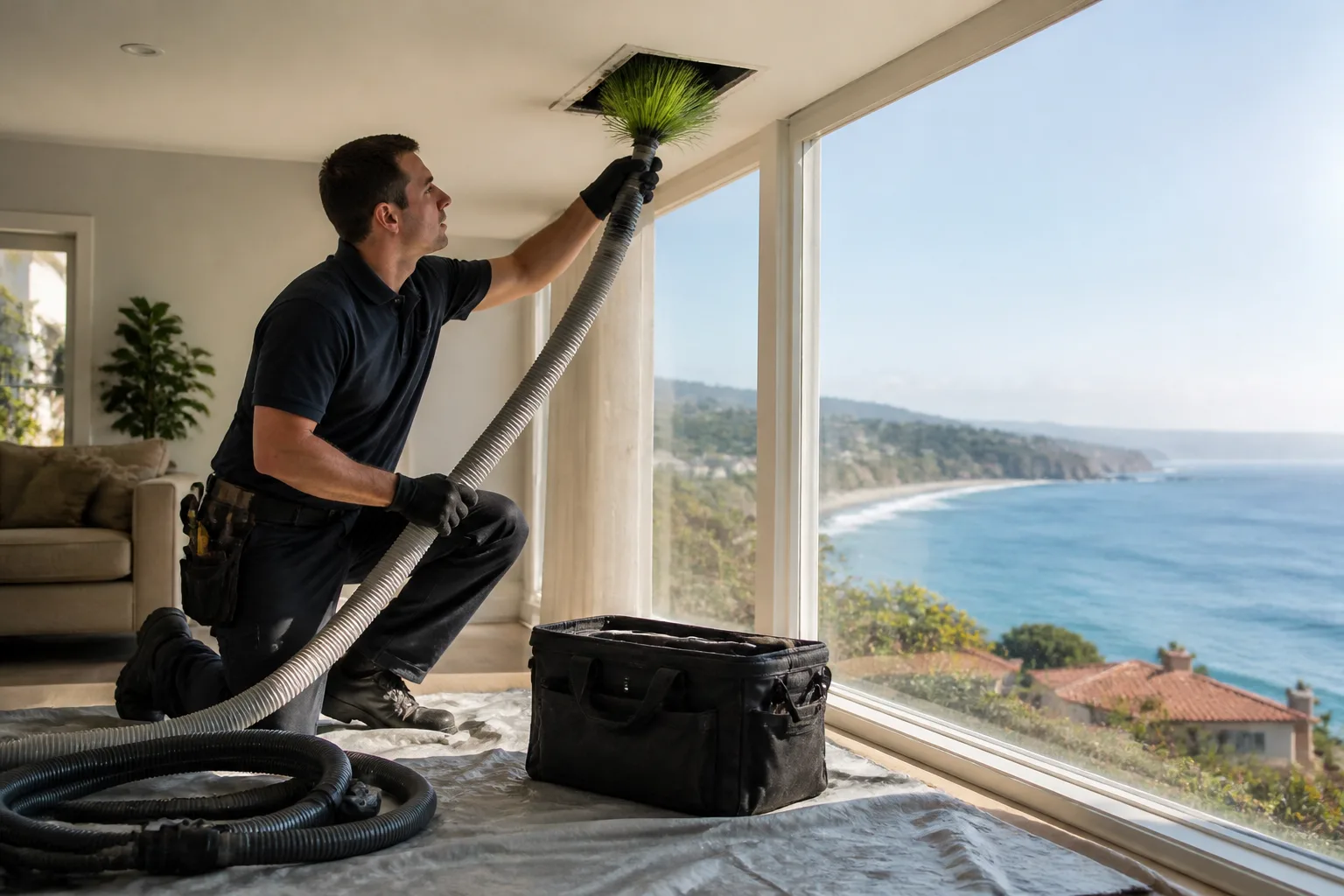
Negative pressure is the whole game. A proper duct cleaning setup pulls a controlled vacuum on the system while a rotary brush or air whip dislodges debris inside. If the vacuum can’t keep up with the agitation, debris escapes into the house. That’s why a company running a shop vac and a spinning brush can look busy for two hours and leave your ducts roughly as dirty as they started – just redistributed.
In our experience around Dana Point, the homes that get the worst results are the ones where nobody asked a technical question during the quote. The homeowner compared three prices, picked the middle one, and never learned what equipment was walking through the door. Ask about capability first. Price is the last thing you compare, not the first.
One practical way to check capability: ask to see before-and-after photos of your own ducts when the job is done. A company confident in its equipment will happily show you.
The NADCA ACR Standard: What It Is and How to Ask About It
The NADCA ACR standard is the industry benchmark for how air duct cleaning should be performed, and a legitimate company should be able to tell you whether they follow it. You don’t need to memorize it. You need to know it exists so you can ask a question that a sales script can’t fake an answer to.
The ACR standard covers the practical mechanics of a proper job: maintaining negative pressure throughout the cleaning, using tools appropriate to the duct material, protecting the occupied space, and documenting the work. When you ask “do you follow the NADCA ACR standard?” you’re really asking whether the company has a defined process or improvises.
Here’s how to ask without sounding like you’re reading from a checklist. Try: “How do you keep the house under negative pressure while you’re working?” A technician who understands the job will describe the vacuum setup in plain terms. Someone following a script will pivot to a discount.
Follow up with a second question: “What does your process look like from arrival to walkthrough?” A company that follows a real standard will describe an inspection, containment, cleaning, and a verification step. If the answer is “we clean all the vents and you’re done,” that’s your signal.
You can also ask whether they’ll put the scope of work in writing before starting. The written estimate should set the price, not a phone quote that grows once the equipment is set up.
Why Truck-Mounted Equipment Matters in Dana Point Homes
Truck-mounted equipment matters in Dana Point because multi-story homes and long hose runs put real demands on vacuum power, and a portable unit can lose suction over distance. A truck-mounted system generates far more airflow than a portable vac, and that airflow is what sustains negative pressure across a whole-house duct system instead of just the room you’re standing in.
Three things to think about for a Dana Point house specifically:
- Power requirements. Big vacuum systems need dedicated power. A truck-mounted unit sidesteps the question of whether your garage outlet can carry the load – and sidesteps tripping a breaker mid-job.
- Hose run distance. In a two- or three-story home, the truck may park at street level while the farthest duct register sits two floors up and at the back of the house. That’s a long run, and suction drops with distance. A company that plans for it brings the right hose lengths and connects close to the system.
- Containment capacity. The vacuum has to hold everything the brush loosens. Undersized equipment means debris gets pushed around rather than captured.
This is why we use Rotobrush and Nikro systems – the same platforms commercial HVAC contractors rely on – rather than shop vacs or blow-and-go methods. Professional-grade equipment isn’t a marketing line here; it’s the difference between a documented clean and a cosmetic one. If a company shows up with a portable unit and a promise, ask how they plan to hold negative pressure on the top floor.
Five Questions to Ask During a Quote
Five questions separate a technician who understands HVAC systems from one following a sales script. Ask them during the phone call or the in-home quote, and listen for specifics rather than reassurances.
- “What’s your CFM rating, and how do you verify negative pressure?” CFM is cubic feet per minute – the measure of how much air the vacuum moves. A real answer includes a number and a method. A vague answer tells you plenty.
- “How do you handle different duct materials?” Flexible duct, sheet metal, and duct board each need different tools and pressure. If the answer is one brush for everything, keep asking.
- “Do you inspect before quoting, and what are you looking for?” A real inspection looks at the air handler, the plenum, accessible duct runs, and the return side – not just the supply registers you can see from the hallway.
- “Are you licensed and insured in California, and can I see documentation?” Duct work connects to a gas furnace. That’s not a place for an uninsured crew. Ask for the certificate of insurance and confirm it’s current.
- “What’s included in the written estimate, and what would cost extra?” You want one flat price per system agreed before work starts, not per-vent pricing that climbs as the job goes.
None of these questions require you to know HVAC repair. They just require the other person to explain their process in plain language. That’s a fair test of any contractor in Dana Point.
What a Legitimate Pre-Job Inspection Looks Like
A legitimate pre-job inspection happens before anyone quotes you a price or recommends an add-on, and it covers the whole system, not just the vents you can see. That order matters. If the first thing you hear is an upsell before anyone has looked at your air handler, the process is running backward.
Here’s what a real inspection involves:
- Opening the air handler cabinet to look at the blower and evaporator coil area
- Checking the return plenum and accessible trunk lines
- Looking at supply registers for visible dust, debris, or poor airflow
- Checking the filter condition and fit
- Noting any disconnected joints, torn flex duct, or failing seals
That last point matters more than most homeowners expect. Loose duct joints and failing seals pull in unconditioned air from attics and crawl spaces, which is why your energy bills climb even when the ducts look clean. Cleaning without addressing compromised seals fixes half the problem. That’s why our service menu covers duct repair and sealing alongside cleaning, so you’re not calling a second vendor for the other half.
A company that skips the inspection and goes straight to the sales pitch is telling you something useful. Believe it.
When to Call a Pro
Not every dusty vent needs a full duct cleaning. But there are clear signs it’s time to stop wondering and get someone out to look:
- Visible dust blowing from supply registers when the system kicks on
- A musty or stale smell that lingers after you change the filter
- Allergy symptoms that get worse indoors, especially after the HVAC runs
- Energy bills climbing without a change in usage
- A dryer that takes two cycles to dry a normal load – that’s a lint buildup signal, and lint in a dryer vent is a fire hazard the NFPA warns about
That last one is why we offer dryer vent cleaning as a dedicated service. Many duct-only companies overlook it entirely, which leaves a leading residential fire risk unaddressed.
If you’re already thinking about the whole system, it’s often the right time for HVAC cleaning as well – the air handler, coil, and blower are where a lot of the debris actually collects.
Verifying Licensing and Insurance in California
Duct work connects to a gas furnace, which makes licensing and insurance a safety question, not a paperwork formality. California requires contractors to be licensed for the work they perform, and the state’s contractor licensing board lets you verify a license number and its status. Ask for the number. Look it up. It takes two minutes.
Insurance matters just as much. A crew working around your furnace and duct system should carry liability coverage and workers’ compensation. Ask for a certificate of insurance and check that the dates are current, not expired. Anyone who hesitates on that request is telling you something.
On our side of the table, we connect homeowners with local pros who are state-licensed and insured as California requires – that’s the baseline, not a selling point. We also use equipment that contains the work properly, including Abatement Technologies negative-air equipment for containment and air scrubbing during service. In a home where one person has asthma or allergies, containment isn’t a luxury – it’s how you keep the job from making things worse before it makes them better.
Don’t Skip the Assessment: What a Real Clean Includes
A real clean starts with assessment and ends with verification, which is why choosing a company is as much about process as it is about equipment. Cleaning is step one. The full job includes repair, sealing, and sanitizing where the inspection calls for it.
After cleaning, a proper company documents what it found and what it did. Before-and-after photos of your own ducts are the simplest proof. Ask for them up front – it’s a fair request and a revealing one.
For homes with microbial concerns after cleaning, we offer Guardsman-grade sanitizing treatments, which bring a commercial-level antimicrobial standard into residential and light-commercial systems. We don’t push it as an add-on on every job. It’s a recommendation that follows an inspection, not a flat fee announced at the door.
If your home has humidity or filtration issues beyond dust, products from Honeywell and Aprilaire address whole-home filtration and humidity control at the source. Those are worth discussing after the ducts are clean, not before.
What happens when you call
- 1
A real person answersNo phone trees – you reach a local pro.
- 2
You get an upfront price rangeHonest numbers before anyone is dispatched.
- 3
A background-checked tech heads outLicensed & insured, dispatched right away.
- 4
You approve before work beginsNothing starts until you say go.
The Bottom Line
Choose an air duct cleaning company in Dana Point by verifying what their equipment can actually do, not by comparing coupons. Ask about CFM rating, negative-pressure verification, and whether they follow the NADCA ACR standard. Ask what happens during the pre-job inspection. Ask for the license number and current insurance. A company confident in its process will answer all of it without flinching.
Cleaning is part of a complete job – repair, sealing, sanitizing, and dryer vent service round it out so you don’t need multiple vendors. Our technicians have up to 12 years of experience, and we use the same Rotobrush and Nikro platforms commercial contractors rely on.
If you’re in Dana Point and need help, Dana Point Air Duct Cleaning Pros offers free estimates. Call (855) 629-3179. We answer 24/7. Fast dispatch from 7am to 7pm, Sunday through Friday. You can also start with air duct cleaning and add the rest based on what the inspection finds.
Frequently Asked Questions
Ask for their CFM rating and how they verify negative pressure during the job. A company using professional equipment will give you a specific answer and describe the vacuum setup; one running a shop vac or blow-and-go method won’t have a real number to offer. Call (855) 629-3179 if you’d like us to walk you through what a proper setup looks like – estimates are free.
The NADCA ACR standard is the industry benchmark for how air duct cleaning should be performed, covering negative pressure, appropriate tools, and documentation. Yes, it’s worth caring about – it’s a concrete way to tell a defined process from an improvised one. Ask any Dana Point company whether they follow it and listen for specifics.
Cheap quotes usually reflect cheaper equipment, skipped inspection, or per-vent pricing that grows once the technician is on site. What looks like a deal can turn into a bigger invoice later. We give one flat price per system agreed before work starts, with before-and-after photos of your own ducts. Call (855) 629-3179 for an exact quote – estimates are free.
Yes. California requires contractors to be licensed for the work they perform, and duct work connects to a gas furnace, so insurance protects you if something goes wrong. Ask for the license number and certificate of insurance, and verify both are current. It’s a two-minute check that tells you a lot about who you’re hiring in Dana Point.
Written by the team at Dana Point Air Duct Cleaning Pros.
Need Air Duct Cleaning Help?
Call Dana Point Air Duct Cleaning Pros - the local pro we connect you with is licensed and insured, with free written estimates in Dana Point.
(855) 629-3179